


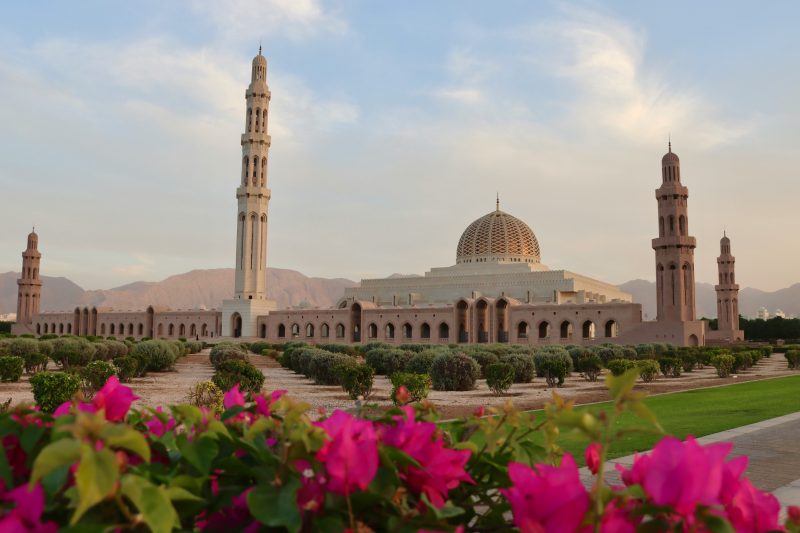
Dragon Trail’s recovery strategy for Oman’s Ministry of Tourism includes large-scale video production, alongside ongoing cooperation with Chinese travel agencies. Photo by Hongbin on Unsplash
How has the Iran war impacted Chinese consumer sentiment about travel to the Middle East and North Africa (MENA), and how should regional travel brands approach the Chinese market now? These are the latest insights from Dragon Trail’s consumer research, market intelligence, and strategy planning.
Consumer Insights
Dragon Trail’s spring 2026 Chinese Traveler Sentiment Survey was conducted just a few weeks after the start of the Iran war, with an official travel warning and airspace closure in effect during this time.
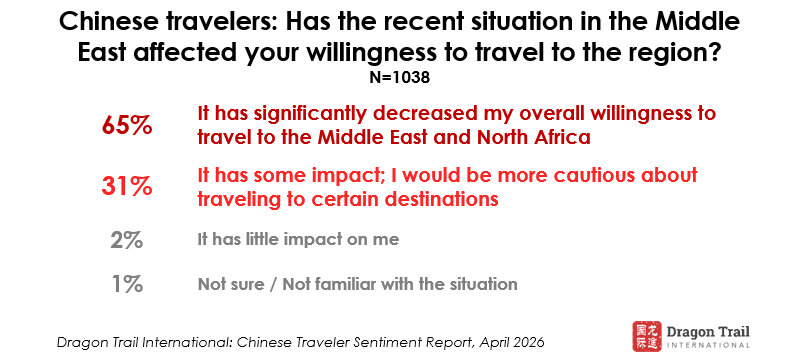
Almost all (96%) of our 1,038 respondents said that the recent situation in the Middle East had negatively affected their willingness to travel to the region, with two-thirds (65%) saying the war had significantly decreased their willingness to travel there.
The Middle East dropped from 7th place to 10th (out of 11) for world regions that survey respondents were interested in visiting, with a decrease of .40 points, or 14%, since spring 2025.
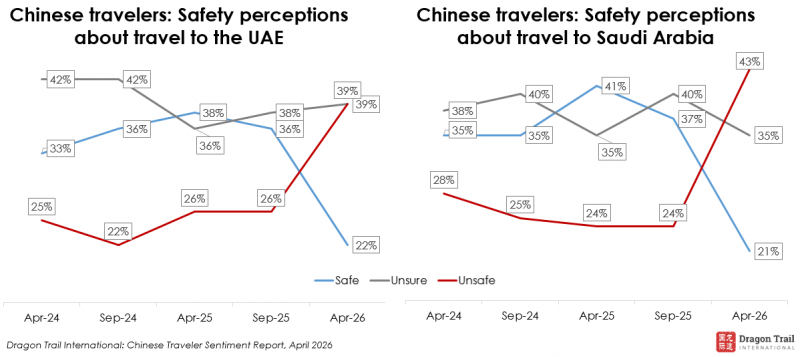
Safety ratings for the UAE and Saudi Arabia have seen significant decreases, after years of stability. In our most recent survey, more respondents said that these countries were unsafe to travel to than safe, for the first time in our polling. However, Egypt’s safety score stayed stable since our September 2025 survey. Although flight disruptions and uncertainty are impacting destinations beyond the immediate conflict zone – including Egypt and Turkiye – our survey results show that Chinese travelers are also differentiating between Gulf countries and those MENA destinations more than a thousand miles away.
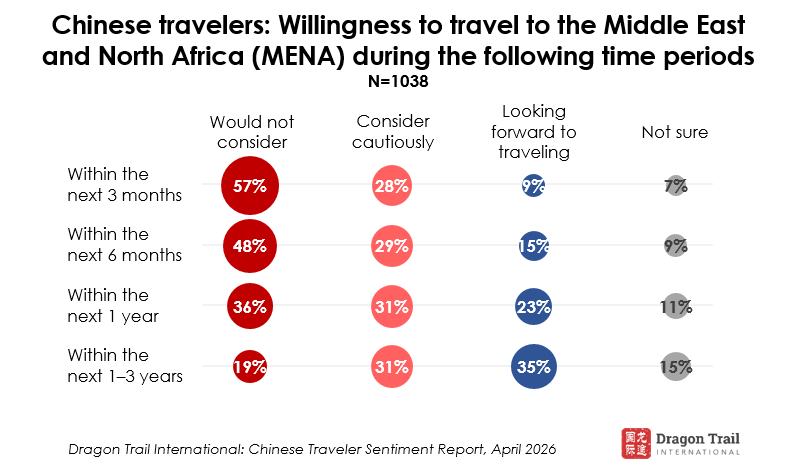
The impact of the war on consumer sentiment is most pronounced in the short-term. Although 57% said they wouldn’t consider travel to MENA in the next three months, this drops to 19% for the next 1-3 years. At the same time, the percentage that said they want to travel to MENA grows as we look ahead further into the future.
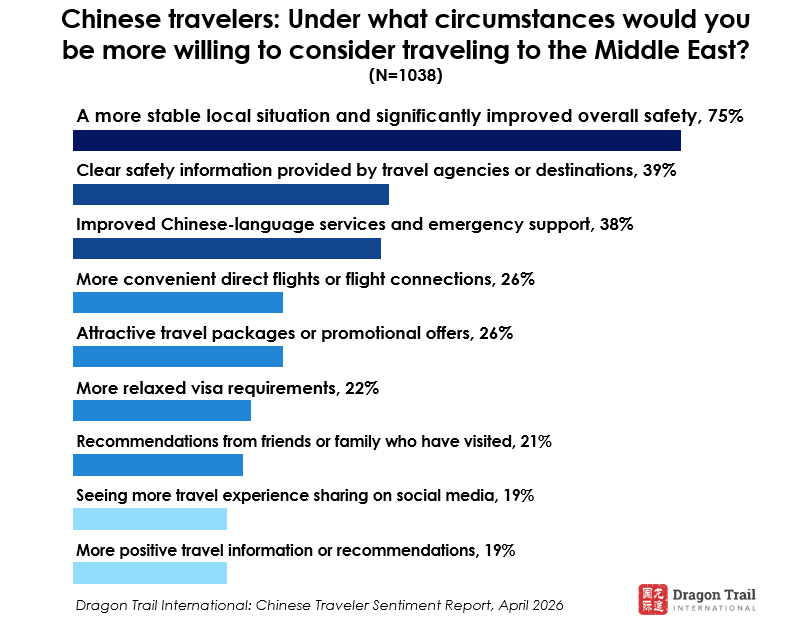
What will it take to make Chinese travelers more willing to consider traveling to the Middle East and North Africa? The majority (75%) of our survey respondents said that the local situation would need to stabilize, with significantly improved overall safety. Consumers will also be looking to destinations and the travel industry to support with additional security measures, including providing safety information (39%) and improved Chinese-language services and emergency support (38%).
Recovery Roadmap: Advice for Regional Travel Brands
Even at this time, travel brands in the region can and should be preparing and positioning themselves for recovery. Here’s what we recommend:
1) Improve China-readiness
Use this downtime to get ready to better host the Chinese market when it comes back. Invest in China-ready training for staff – such as through Dragon Trail’s China Outbound Tourism Academy (COTA) online training, or improving Mandarin skills. Businesses can also audit and improve their China-readiness through preparing translated materials and China-friendly amenities, opening a WeCom account for customer service, and getting set up to accept Chinese mobile payments through Alipay and/or WeChat Pay.
2) Stay in touch with the Chinese travel trade
Long-term, continuous relationships are the most valuable in this market. Keep Chinese travel trade partners up to date with regular communications, as well as webinars and training programs so they can learn more about your product and destination for future reference.
3) Develop products to suit the recovery market
Your products and marketing will need to be tailored to suit those travelers who are likely to return first. Think about developing products and strategies aimed at experienced FITs, business travelers, the luxury market, and small and customized groups, and speak to your Chinese travel trade partners for their advice on the products and demographics they recommend prioritizing first.
4) Rebuild trust through in-person visits
When things start to settle, there will be important work to do to rebuild trust and traveler confidence, through FAM trips and influencer marketing. This work can also begin even earlier with live streaming and video content for a Chinese audience.
Here are a few additional tips for recovery, with real examples from the global tourism industry:
• Don’t view the crisis as a reason to withdraw from the Chinese market. As a COVID-era example, Spain’s tourism board stayed highly engaged with the Chinese market during the pandemic. Even during the height of China’s zero-COVID policy, when there was nearly no outbound tourism at all, Turespaña organized hours of live streaming and other marketing engagement with Chinese consumers. Since China reopened, Spain has stood out as the western European country that recovered fastest, surpassing pre-pandemic Chinese arrival numbers by 2025.
• Like consumers, travel brands will need to keep their focus on the long-term – Etihad’s 13 April announcement of five new China routes and 28 additional weekly China flights is exactly the kind of long-term strategic thinking that will help the market to recover and grow. Etihad’s Abu Dhabi-Shanghai flights are scheduled to be launched in October 2026, with routes to Guangzhou, Chengdu, Hangzhou, and Shenzhen to launch in March 2027.
• While Dubai is a relatively well-established travel destination for the Chinese market, most Gulf destinations are still very new for Chinese travelers, and a large volume of general awareness content is essential. As part of Dragon Trail’s recovery plan developed for the Oman Ministry of Tourism, we’re designing and producing a library of creative video content during this time, to promote the destination from more diverse angles and increase awareness and consistent visibility in the Chinese market.
Dragon Trail has specialized in marketing for Chinese outbound tourism since our founding in 2009. We have extensive expertise and experience working with clients in MENA, including Oman, the UAE, Saudi Arabia, and Egypt. Our first white paper on Chinese tourism to MENA was published in November 2025. We spoke at ATM Dubai in 2023 and 2024, and will join the 2026 event as an official Research Partner.
Please get in touch with us to discuss your recovery strategy for the Chinese market and how we can support.
The wonderful partners we work with






Sign up for our free newsletter to keep up to date on our latest news
We do not share your details with any third parties. View our privacy policy.
This website or its third party tools use cookies, which are necessary to its functioning and required to achieve the purposes illustrated in the cookie policy. If you want to know more or withdraw your consent to all or some of the cookies, please refer to the cookie policy. By closing this banner, scrolling this page, clicking a link or continuing to browse otherwise, you agree to the use of cookies.