


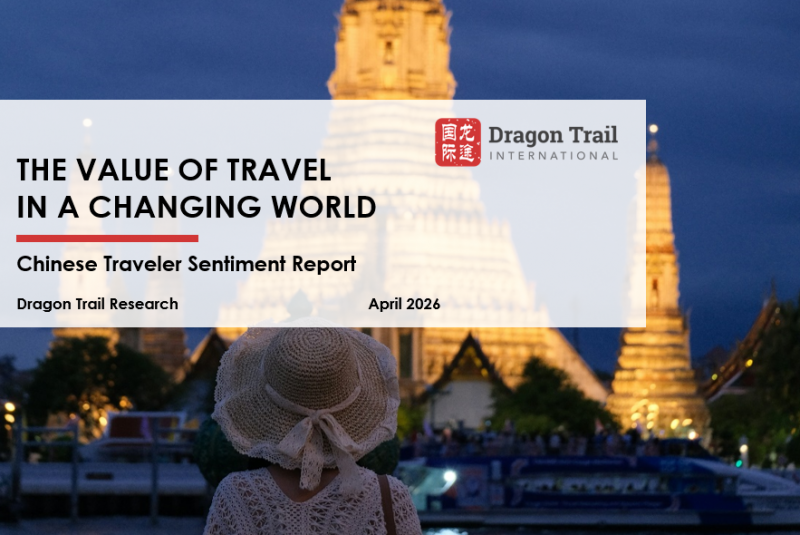
Much has changed in the world since Dragon Trail’s last Chinese Traveler Sentiment Report, published in September 2025. Several developments in particular have impacted Chinese outbound tourism. The fallout from a diplomatic incident in November 2025 has halved flight capacity from China to Japan – which had been riding high as the top international destination for Chinese travelers for some time. Tourism to the Middle East – a rapidly growing new hotspot – suddenly came to a standstill in March 2026 after the outbreak of war in the region.
How are Chinese consumers reacting to these events? Our latest Chinese Traveler Sentiment Survey, conducted between 16-20 March 2026, with 1,038 respondents, offers answers.
Click here to view and download the full report
(Users in China: if you cannot open the above link, please contact us directly to receive your copy of the report)
Outbound travel intention has softened compared to last year, but it remains higher than in 2024. Trends like longer trips, increased spending on experiences, and the substantial influence of Chinese social media platforms like RedNote on outbound travel inspiration and planning are all still going strong.
The Iran war has already had a major impact on Chinese travelers’ plans, and safety perceptions for Gulf countries have fallen significantly. Japan, usually perceived as a relatively “safe” travel destination by Chinese consumers, has dropped to its lowest safety rating since China lifted COVID-era restrictions on international travel. However, Japan remains firmly in the top 10 list of travel destinations, with survey respondents still inspired to visit through social media content. At the same time, Thailand is making a comeback, recovering at last from poor safety perceptions over the past few years. Vietnam’s safety rating has also improved, and we see growing intention to travel to Southeast Asia.
Amid the stresses of world events and everyday life, Chinese consumers are seeking relaxation as a central motivation for travel – it’s the top reason survey respondents gave for traveling outbound during the upcoming May Labor Day holiday. In this report, we’ve included a deep dive on wellness travel to explore this theme further – looking into what kinds of wellness and sports-related activities are most in demand among Chinese travelers, who is seeking these experiences, why, and what they’re willing to pay for them.
China’s outbound travel market is highly safety conscious, but also resilient and looking for new adventures. We hope this report will prove valuable to global travel brands in understanding what Chinese travelers are seeking, what most inspires them, and how they will be planning and booking their next outbound trips.
These are our 6 top takeaways from the report:
1) May holiday will bring longer, regional trips
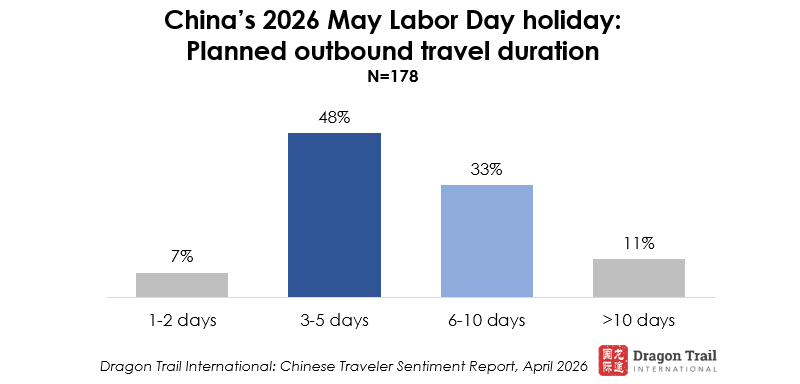
24% of respondents who intended to take an outbound trip in 2026 said they planned to do so during the May Labor Day holiday (1-5 May). Most trips will be intra-regional, with South Korea, Macau, Thailand, and Hong Kong the top destinations. Close to half (44%) of respondents plan to take extra leave to extend their holiday, with 33% expecting to travel for 6-10 days, and 11% planning to travel for more than 10 days.
2) Regional preferences and safety rankings show major shifts
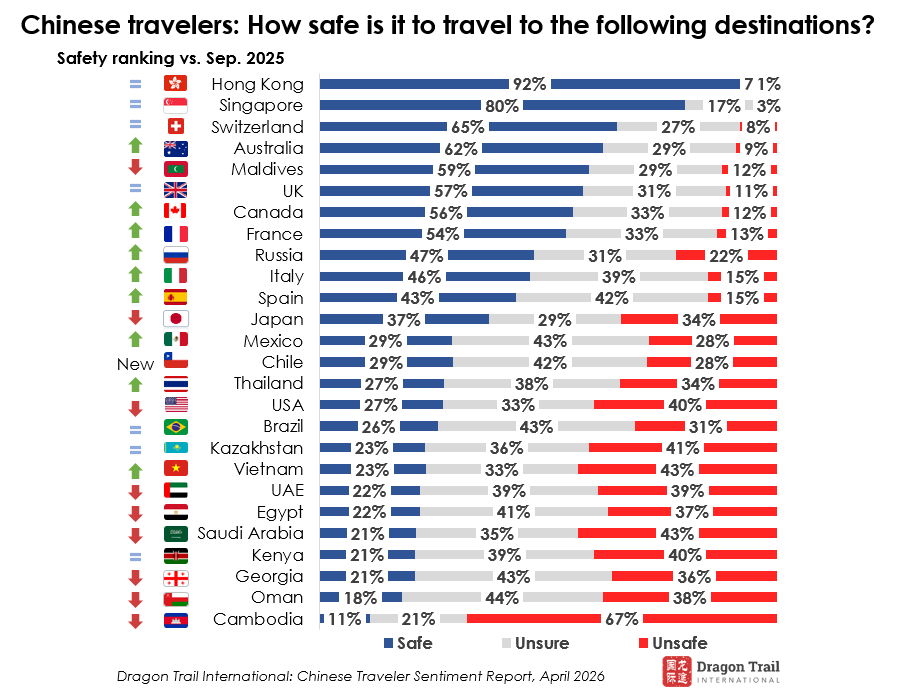
Thailand is experiencing a strong comeback among Chinese tourists this year, with improving safety ratings, a boost in the percentage of survey respondents who plan to travel there for the May holiday, and greater traveler intention to visit Southeast Asia. In contrast, the impact of China’s travel advisory for Japan is reflected in a sharp decline in public perception about Japan’s safety as a travel destination. With the outbreak of war in the region, safety rankings and travel intention for the Middle East both saw considerable drops.
3) The Iran war has already had a profound impact on Chinese travel plans
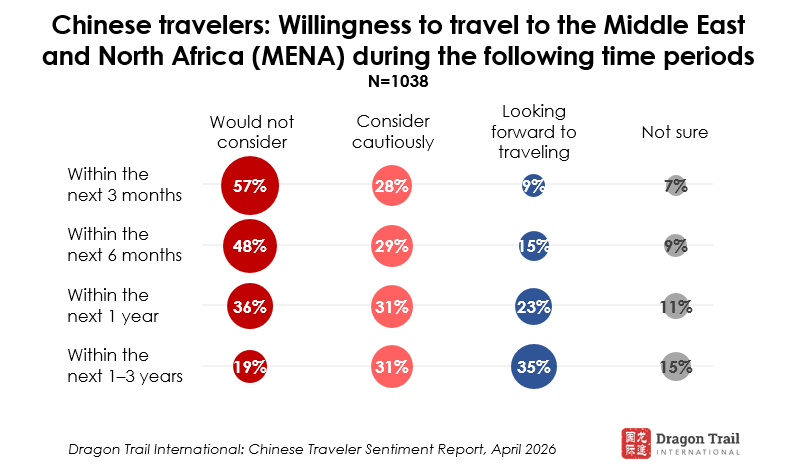
Survey respondents identified the international security situation as the top factor influencing their outbound travel decisions. 43% of survey respondents’ travel plans have already been impacted by the Iran war, and we see softening travel intention to nearly all world regions. Two-thirds (65%) said the war had significantly decreased their willingness to travel to the Middle East and North Africa. Understandably, this impact is most pronounced in the short-term.
4) Chinese travelers plan to increase spending on experiences
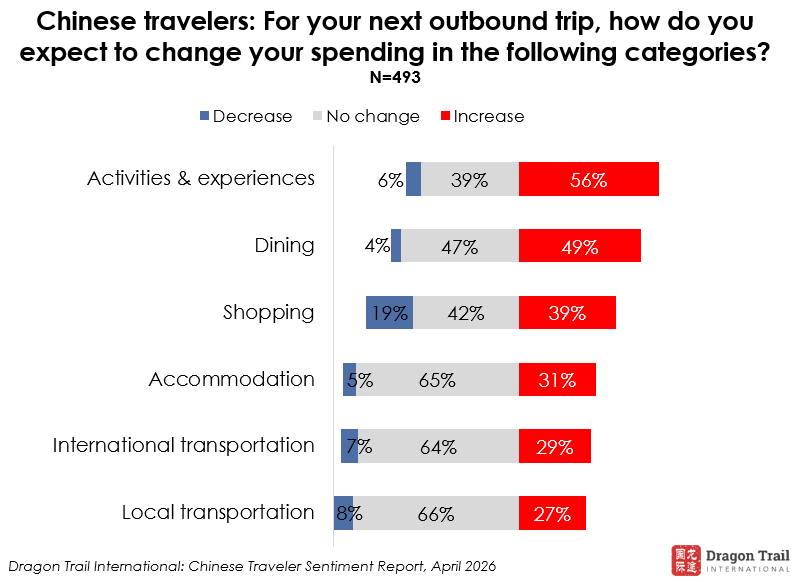
Over half (56%) of Chinese outbound travelers say they are planning to increase spending on activities and experiences, with 49% planning to increase spending on dining. Young travelers aged 18-24 showed a stronger intention to increase spending across all categories – including shopping and accommodation – compared to travelers from other age groups.
5) Social media content – especially natural scenery – inspires Chinese travelers
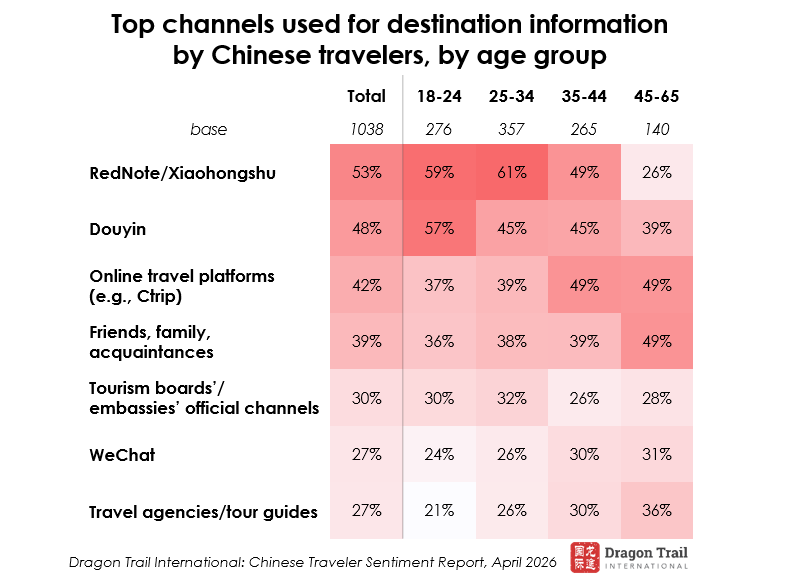
RedNote (Xiaohongshu) remains the top source of outbound travel information, chosen by 53% of respondents in this survey. Following closely are Douyin, and OTAs like Ctrip. Chinese travelers said they were inspired by social media to visit a wide range of places, with content featuring natural scenery the most influential.
6) Relaxation and stress relief are Chinese travelers’ top wellness goals
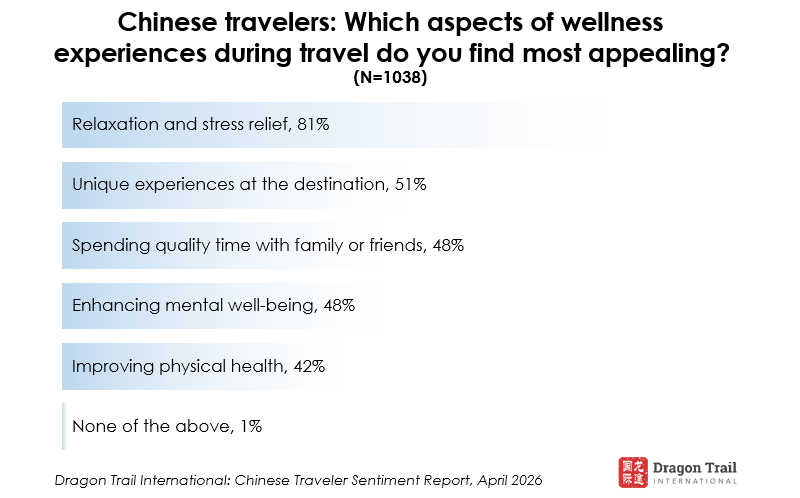
Most Chinese travelers are open to integrating some wellness experiences into their trips, especially with the goal of relaxation and stress relief. Spa and hot spring experiences, and nature-based healing activities are most popular. Most survey respondents say they are willing to pay a limited premium to add wellness activities into their travel experience.
About this report
The April 2026 Chinese Traveler Sentiment Report is published by Dragon Trail Research (a division of Dragon Trail International), based on our own survey of 1,038 Chinese travelers in first-tier, new first-tier, second-tier, and third-tier cities throughout China. In addition to these reports, Dragon Trail Research also offers a number of services to travel brands and businesses, including bespoke consumer and trade surveys, focus groups and more. Please click here or contact us for more information on how we can help you get the information you need on China’s travel market.
About Dragon Trail
Dragon Trail Research is a division of Dragon Trail International, an award-winning marketing solutions company with roots in China and extensive experience in the global travel and MICE sectors. Since 2009, our international team of digital solutions and marketing specialists has been helping leading brands around the world to become more globally connected and competitive. Our clients include national and regional destination marketing organizations, event organizers, international organizations, hotels, airlines, cruise lines, attractions, retailers and more.
The wonderful partners we work with






Sign up for our free newsletter to keep up to date on our latest news
We do not share your details with any third parties. View our privacy policy.
This website or its third party tools use cookies, which are necessary to its functioning and required to achieve the purposes illustrated in the cookie policy. If you want to know more or withdraw your consent to all or some of the cookies, please refer to the cookie policy. By closing this banner, scrolling this page, clicking a link or continuing to browse otherwise, you agree to the use of cookies.